
By | Sarah Khadijah Taylor, Mohd Sharizuan Mohd Omar, Muhammad Nooraiman Noorashid, Muhammad Faridzul Sukarni & Mohd Izuan Effendy bin Yusof
Cryptocurrencies & the Industry
There is no denying that cryptocurrencies have taken the world by storm. The market cap of cryptocurrencies shows astonishing numbers (CoinMarketCap.com, 27th June 2019). Bitcoin, the largest cryptocurrency, shows a market cap of $235 billion, while Ethereum, the second largest group, shows a market cap of $36 billion followed by XRP with $19 billion. It is worth mentioning that Bitcoin is traded at USD 13,200 per unit in 2019 compared to USD291 in 2015, which denotes an increase by more than 4,000% in a short time span. The mechanism of cryptocurrencies that are known for being anonymous, low hassle and have fast transfer rates has attracted many users.
As the cryptocurrency industry is accelerating worldwide, Malaysia is not lagging behind but is embracing this new fintech. In Malaysia, the cryptocurrency market is progressing positively. According to Luno, one of the only three registered digital asset exchanges in Malaysia, a total of USD 38,711 or 3.60 bitcoins are being traded daily in Malaysia. On average, Malaysians do cryptocurrency transactions approximately every 5 minutes. Altogether 56 companies have already declared dealing with digital currencies to Bank Negara Malaysia.
In terms of technology, the most unique and novel features of cryptocurrencies by far are the blockchain and its digital representation that contains intrinsic values. Blockchain is a distributed ledger in a peer-to-peer network to store records of transactions online. Each transaction is protected using a cryptographic algorithm, hence the records are secured and immutable. Each node joining the network is known as a miner and their task is to create (or mine) new blocks. A consensus mechanism is used to complete a transaction, therefore the whole process does not require an authority to authorize the transaction. The blockchain technology is employed in cryptocurrencies to generate electronic cash and to conduct transactions.
Cryptocurrencies and Regulations around the World
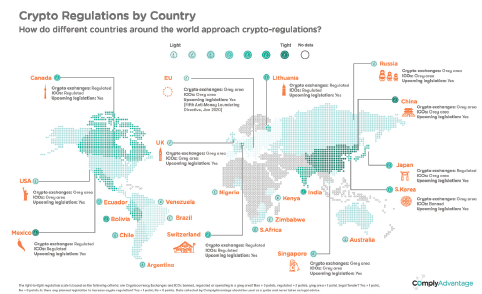
Quite a number of countries around the world have already regulated cryptocurrencies, such as Japan, Switzerland, Lithuania, Canada and Mexico (Figure 1). Exchangers intending to trade cryptocurrencies need to register and comply with their countries’ regulations.
In terms of the Initial Coin Offering (ICO), countries like Canada, Mexico and Switzerland support this business and have already regulated it. On the other hand, countries like South Korea, Bolivia and China have banned ICO in their countries.
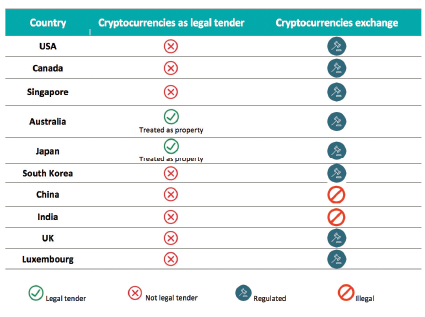
The standing of the regulations is illustrated in Table 1.
Regulation of Cryptocurrencies in Malaysia
In 2014 Bank Negara Malaysia published a warning on the use of Bitcoin on its website. Bitcoin was not recognized as legal tender and therefore Malaysians were advised to take necessary precautionary steps should they choose to use it.
However, the government later took steps toward regulating cryptocurrency exchange. The Attorneys General’s Chamber (AGC) issued a Federal Government Gazette in January 2019 in its ‘Capital Markets and Services (Prescription of Securities) (Digital Currency and Digital Token) Order 2019’ to regulate cryptocurrencies.
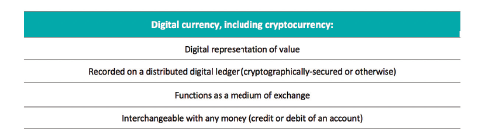
The Order contains an interpretation of ‘digital currency,’ under which cryptocurrency is categorized. Digital currency is defined as a digital representation of value which is recorded on a distributed digital ledger whether cryptographically-secured or otherwise, that functions as a medium of exchange and is interchangeable with any money, including through the crediting or debiting of an account.
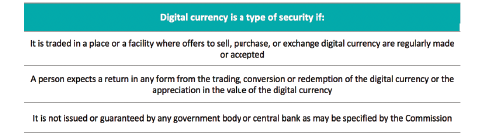
Digital currency is regarded as a security under Malaysian law if it achieves several requirements described in the following statement.
Digital currency is prescribed as a security if it satisfies the following:
In summary, Malaysia recognizes the use of cryptocurrency as a security, hence it can be used legal tender. Cryptocurrency exchanges are also legal and regulated in Malaysia, provided they are registered with the Securities Commission. To date, 3 exchanges are already operating legally in Malaysia – Luno, Tokenize and Sinegy – as listed by the Securities Commission.
Why do we need it to be regulated?
‘If it is so good at its current state, then why do we need to regulate it?,’ the public may ask. Before making any conclusions, allow us to explain cases reported to law enforcement around the world.
In the United Kingdom, six people have been arrested as part of an investigation into the theft of more than £22 million worth of cryptocurrency from an estimated four thousand-plus victims worldwide. In the US, victims of Homero Joshua Garza’s virtual currency scam have lost more than $9 million worth of cryptocurrency. In the middle of this year Japanese exchange BITPoint was hacked, causing its users a loss of $28 million. According to CipherTrace, cybercriminals have netted $4.3 billion from digital currency exchanges, investors and users in 2019. Digesting the losses of public users on a worldwide scale, no doubt regulations must be in place to curb this issue.
Regulations of cryptocurrencies are fundamentally created for the purposes of:
- Creating standards that allow interoperability and protect end users;
- Ensuring the protection of vulnerable people from criminals; and
- Ensuring good governance to protect investors as well as end users from fraud, mismanagement and gross negligence.
In a nutshell, cryptocurrencies need to be regulated in order to prevent money losses.
Conclusion
Malaysia is moving progressively with the rest of the world in embracing cryptocurrency as a new fintech mechanism. With the regulations on digital currency exchange, Malaysia is creating a harmonious and safe ecosystem for the public and industry to participate in fintech developments.